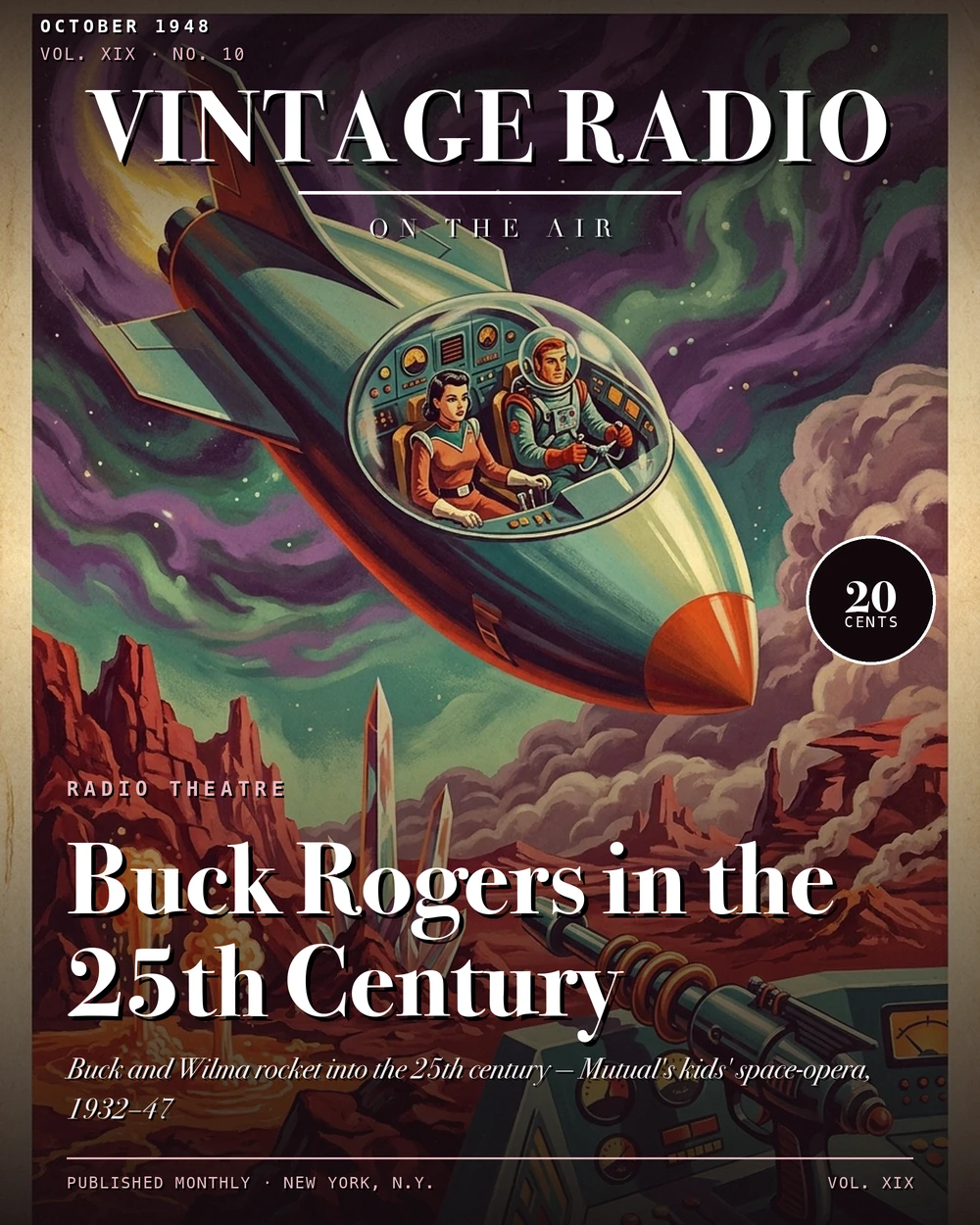
Buck Rogers in the 25th Century
The Show That Launched a Future
When Buck Rogers first hit the airwaves on November 7, 1932, it was the first science fiction program ever broadcast on American radio — a juvenile adventure serial built around a hero who had been cheated out of five centuries of his own life and was now doing his best to make up for it. The premise came straight from the comic strip created by John F. Dille, Dick Calkins, and Phil Nowlan, which itself had been adapted from Nowlan's 1928 novella "Armageddon 2419 A.D.," published in Amazing Stories. Buck had been surveying an abandoned mine in 1919 when a cave-in knocked him cold. A mysterious gas seeped into the chamber and held him in a kind of suspended animation for five hundred years. He woke up in the 25th century to find that everything he had ever known was gone.
That setup gave the show a quality most juvenile adventure programs couldn't match: a hero who was genuinely disoriented, navigating a world he hadn't asked to enter. The capital city was Niagara. Space fleets waged war. Killer Kane and his accomplice Ardala Valmar were always stealing something dangerous. And Buck's friend Dr. Huer was perpetually inventing gadgets with names like the "gyrocosmic relativator" and the "mechanical mole" that would inevitably end up in the wrong hands within a few episodes.
Four Runs Across Fifteen Years
The show had a surprisingly long and scattered broadcast life, coming and going across different networks and time slots in a way that reflected the uncertain economics of radio's early decades. The first run opened on CBS on November 7, 1932, and stayed there until May 22, 1936 — a four-year stretch with three sponsors cycling through. Kellogg's backed a 15-minute weekday slot at 7:15 in the first season. Cocomalt took over in 1933 and moved the show to Monday-through-Thursday at 6. Cream of Wheat finished out the CBS era from 1935, three times a week at the same hour. All three were the kinds of sponsors you'd expect for a show aimed at children — and Cocomalt got its money's worth, offering a cardboard ray gun with helmet and accessories as a 1933 premium.
Then the series went quiet for a few years. It came back on Mutual in the spring of 1939 for a brief three-times-a-week run through the summer, with multi-part story arcs carrying titles like "The Gyro-Cosmic Relativator" (twelve parts), "The Mechanical Mole" (seven parts), and "The Chase After Killer Kane" (five parts). The serial returned to Mutual in the summer of 1940 for a Saturday noon half-hour slot. The final run launched in the fall of 1946 on Mutual, sponsored by General Foods for Post Cereals, and aired as a weekday 15-minute continuation at 4:45 in the afternoon — right in the after-school window. That last run ended March 28, 1947. Across all four runs, an estimated 860 episodes were broadcast, though that figure carries some uncertainty and fewer than thirty are known to circulate today.
The People Who Played Buck
One of the more interesting things about a serial that ran, on and off, from 1932 to 1947 is how many actors ended up cycling through the lead role. Curtis Arnall played Buck Rogers when the show launched in 1932. Matt Crowley took the role in the mid-1930s, followed at some point by Carl Frank. John Larkin stepped in for the final 1946–47 run.
The supporting cast had its own continuity — or the appearance of it. Edgar Stehli played Dr. Huer, Buck's trusted friend and the show's resident inventor, in the original 1930s run and then came back for the 1946–47 run as well. Adele Ronson played Wilma Deering — a lieutenant in the space corps and the series' heroine — during the earlier serial years, with Virginia Vass taking the role in the final run. Wilma was an unusual figure for 1930s science fiction: an accomplished pilot and warrior who happened to be female, treated by the writers as Buck's equal in the cockpit. The villains rotated actors too. Bill Shelley, Dan Ocko, and Arthur Vinton all put in time as Killer Kane, while Jack Roseleigh and Joe Granby both played Black Barney, a former space pirate from Mars who had come around to the right side of things — described as stupid but friendly. Elaine Melchior played Ardala Valmar, the evil adventuress who teamed with Kane on most of the scheming, and Ronald Liss played Buddy. Paul Douglas and Fred Uttal both served as announcers at different points.
How Jack Johnstone Ran It
The creative engine behind the 1930s serial was Jack Johnstone, who served as writer, producer, and director — essentially running the whole operation after Carlo De Angelo handed off the producer-director chair. Johnstone built the show around a repeating structure that kept young listeners coming back: Dr. Huer invents something remarkable, Killer Kane and Ardala steal it, Buck and Wilma have to get it back. He kept the fantasy elements vivid, leaning into death rays, gamma bombs, and warring space fleets. The writing team included Joe Cross, Albert G. Miller, Dee Falkinburg, and Dick Calkins — one of the strip's co-creators — and Ora Daigle Nichols handled sound effects for the CBS years. Recalling the work decades later in 1988, Johnstone described how he and Nichols built the sound of the rockets by routing noise through an air-conditioning vent — the kind of low-budget improvisation that gave early science fiction radio its texture.
The formula was effective enough that it ran for years, but it also drew a particular kind of parental scrutiny. Parents in the 1930s debated the propriety of Buck spending so much time alone with Wilma on long space flights — a concern that drew comparisons at the time to similar hand-wringing about Tarzan and Jane. The show's producers never seemed to find this especially threatening.
Buck Rogers Stuff
The show, the strip, and the merchandise all reinforced one another in ways that shaped American popular culture. By 1935, the phrase "Buck Rogers stuff" had become a national catchphrase for anything fantastically advanced — a piece of slang that turned up in newspapers and cultural criticism alike. The Daisy Manufacturing Company introduced the XZ-31 Rocket Pistol, a 9.5-inch pop gun, at the American Toy Fair in February 1934 for fifty cents; it sold an estimated two million units in its first year, forcing Daisy to run production nights and Saturdays to keep up. Macy's set up dedicated Buck Rogers displays. Some historians of the merchandising business point to Buck Rogers as the start of modern character-based licensing — the moment when a fictional name and image began driving sales of products made specifically because of that character.
The radio show's reach went further still. Gene Roddenberry later cited Buck Rogers as a primary influence on Star Trek, and George Lucas pointed to the Buck Rogers and Flash Gordon serials he had watched on television as a child when explaining where Star Wars came from, opening crawl included. Ray Bradbury, Harlan Ellison, Leigh Brackett, Edmond Hamilton, and Jack Williamson all named Buck Rogers among their early science fiction touchstones. And in 1953, Chuck Jones directed a Looney Tunes cartoon called Duck Dodgers in the 24½th Century — a direct spoof that has now outlasted, in cultural memory, much of what it was spoofing.
How It Ended
The final episode of the 1946–47 run gave the series something it had been building toward for a long time: Buck and Killer Kane's definitive confrontation. The two fought to the finish in a scene that took up most of the episode, settling the long rivalry that had been at the center of the show since the beginning.
And then, at the very end, Buck suggested to Wilma that they take a vacation in Niagara — a closing note that carried a quiet joke for anyone who caught it. In Buck's original time, Niagara Falls was synonymous with honeymoons. For a man who had woken up five centuries too late and spent years fighting space pirates and recovering stolen inventions, suggesting a trip to Niagara as a "vacation" was his way of finally arriving somewhere — even if the show had to end to let him get there.